
April 14, 2025
v 1.2.8
Article By Anil Jain | AI / ML Architect | Data Architect
The article explores two emerging protocols shaping modern AI agent systems: Model Context Protocol (MCP) and Agent-to-Agent (A2A). MCP allows a single AI model to access tools, APIs, and data, while A2A enables multiple agents to communicate and collaborate on tasks. It explains their architectures, use cases, key differences, and how they complement each other. Sample projects demonstrate how to build an MCP server and an A2A agent. The piece concludes by highlighting their role in building autonomous, intelligent systems and points to further resources for developers and enterprises

Introduction
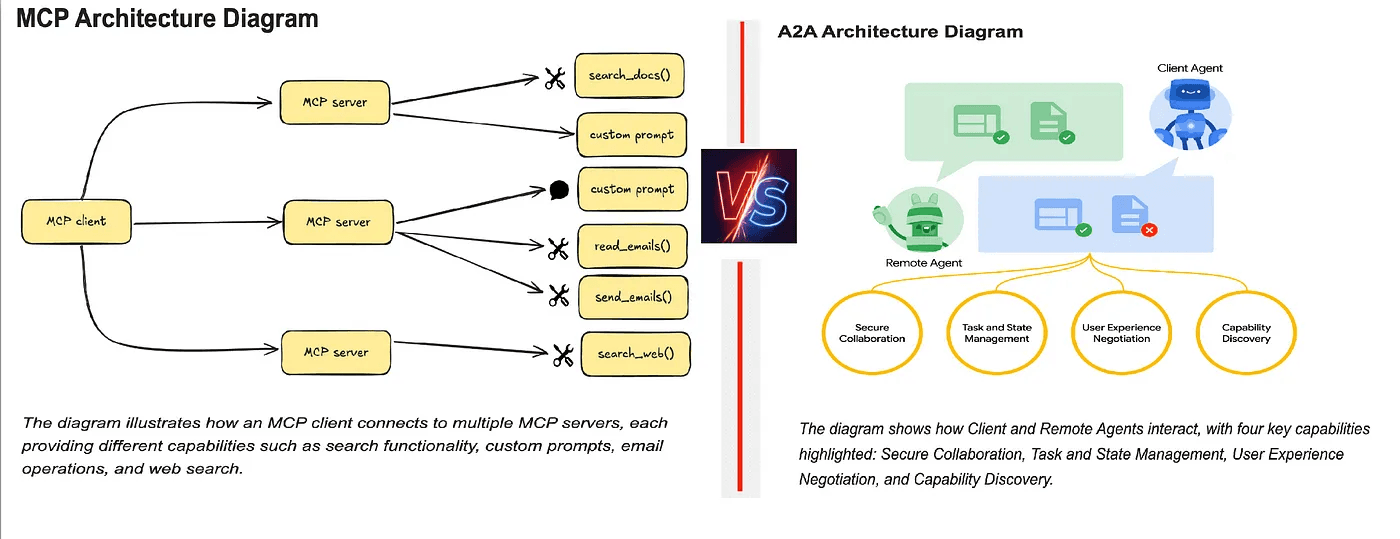
Modern AI systems are increasingly built as agents that can interact with tools, data sources, and other agents to accomplish complex tasks. Two important architectural standards have emerged to facilitate these interactions: the Model Context Protocol (MCP) and the Agent-to-Agent (A2A) protocol. This guide explores both architectures, highlighting their differences, suitable scenarios, and providing sample projects to get started
Key Points
Agentic MCP (Model Context Protocol) enhances single AI agents by connecting them to tools and data, while A2A (Agent-to-Agent) enables multiple agents to communicate and collaborate.
It seems likely that MCP and A2A are complementary, not competitive, with MCP focusing on tool access and A2A on inter-agent coordination.
The evidence leans toward using MCP for tasks needing external resources and A2A for multi-agent workflows, with ongoing development shaping their future.
Agentic MCP and A2A Overview
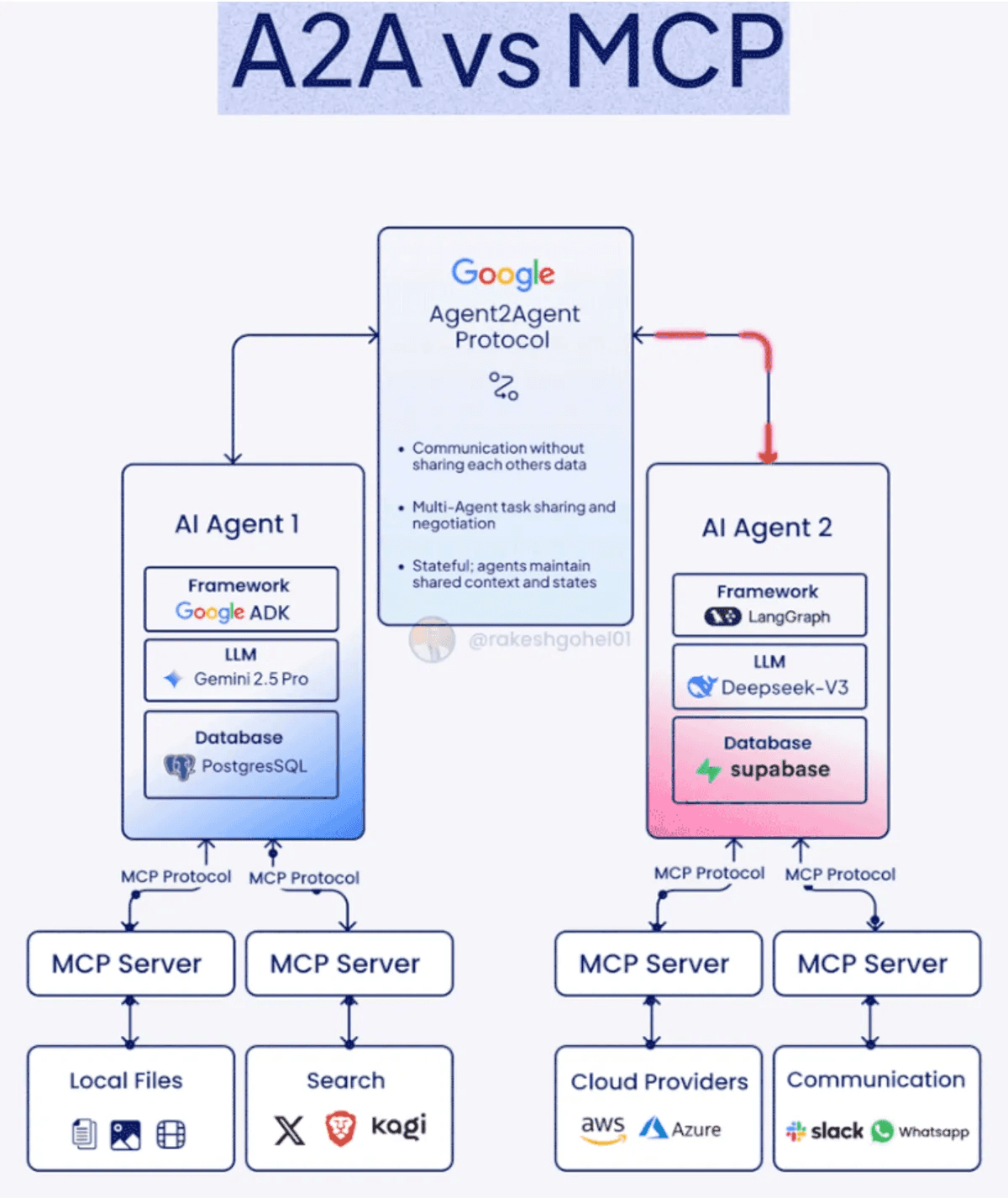
Agentic MCP (Model Context Protocol) is a protocol that helps AI models, like chatbots, connect to external systems such as databases or business tools. It’s like giving the AI a set of tools to fetch information or perform tasks during a conversation, making it smarter and more helpful.
A2A (Agent-to-Agent) Architecture is about letting different AI agents talk to each other. Imagine a team where each agent has a job, like one handles customer queries and another manages tickets — they can work together smoothly using A2A.
Both are part of the growing field of AI agents, which are software entities that reason and act on behalf of users, and they’re shaping how we build intelligent systems.
4. Agentic MCP Architecture
4.1 What is MCP?
The Model Context Protocol (MCP) is an open standard introduced by Anthropic that standardizes how AI models connect with external tools, data sources, and services. It acts as a “USB-C port” for AI applications, providing a universal interface between models and the outside world.
4.2 Core Components
MCP follows a client-server architecture with the following key components:
MCP Hosts — Programs using LLMs (like Claude Desktop or IDEs) that initiate connections to access external data and tools
MCP Clients — Protocol clients embedded within the host application that maintain 1:1 connections with servers
MCP Servers — Lightweight programs that expose specific capabilities through the standardized protocol
Data Sources — Both local (files, databases) and remote services (APIs) that MCP servers can access
4.3 MCP Architecture Diagram
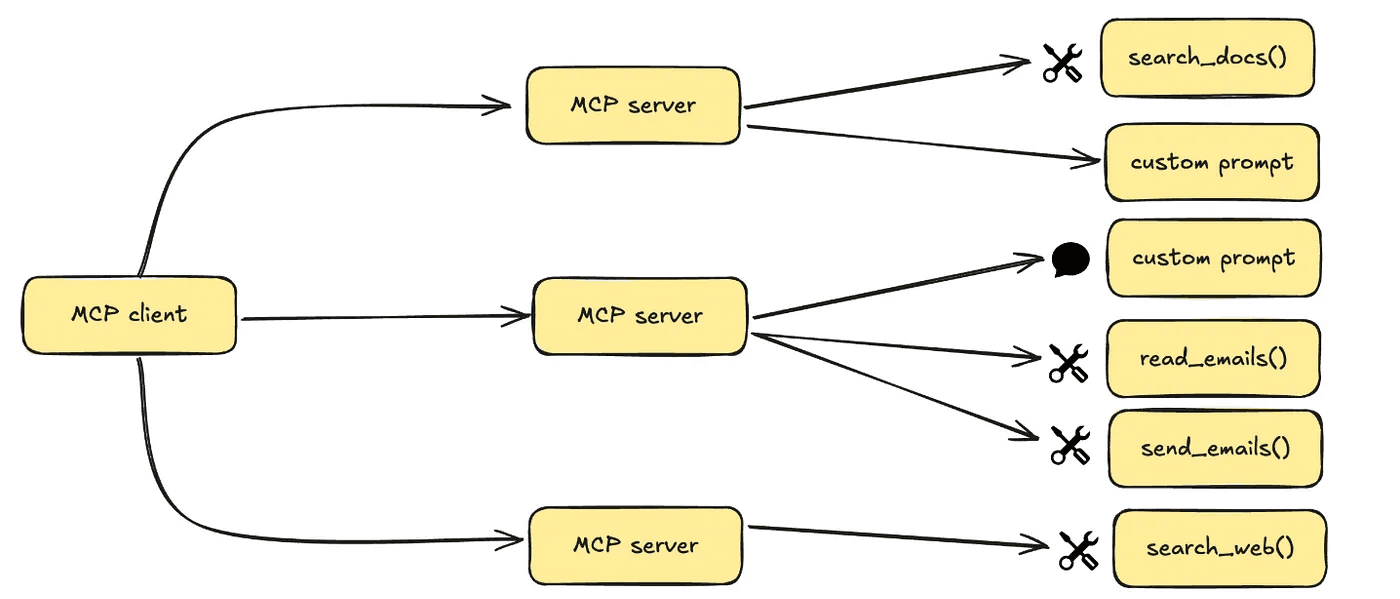
The diagram illustrates how an MCP client connects to multiple MCP servers, each providing different capabilities such as search functionality, custom prompts, email operations, and web search.
4.4 How MCP Works
MCP standardizes three main types of capabilities:
Tools — Functions that can be called by the LLM (with user approval)
Resources — File-like data that can be read by clients (API responses, file contents)
Prompts — Pre-written templates to help users accomplish specific tasks
The protocol operates through a defined connection lifecycle:
Client sends an
initializerequest with protocol version and capabilitiesServer responds with its own protocol version and capabilities
Client sends an
initializednotification as acknowledgmentNormal message exchange begins using request-response patterns and notifications
Either party can terminate the connection through various methods
MCP uses JSON-RPC 2.0 as its message format, transported via either standard I/O (for local processes) or HTTP with Server-Sent Events (for remote communication).
5. A2A Architecture
5.1 What is A2A?
The Agent-to-Agent (A2A) protocol, introduced by Google, is an open standard designed to enable AI agents to communicate, share information, and collaborate effectively, regardless of the underlying framework or vendor.
5.2 Core Components
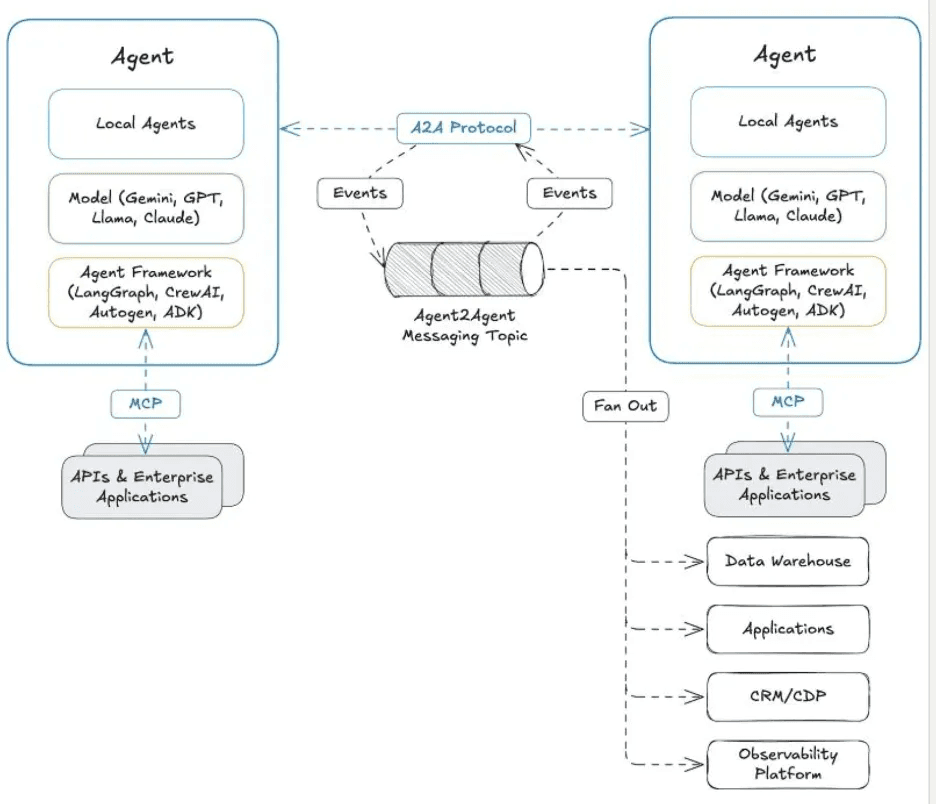
A2A architecture centers around facilitating communication between agents with these key components:
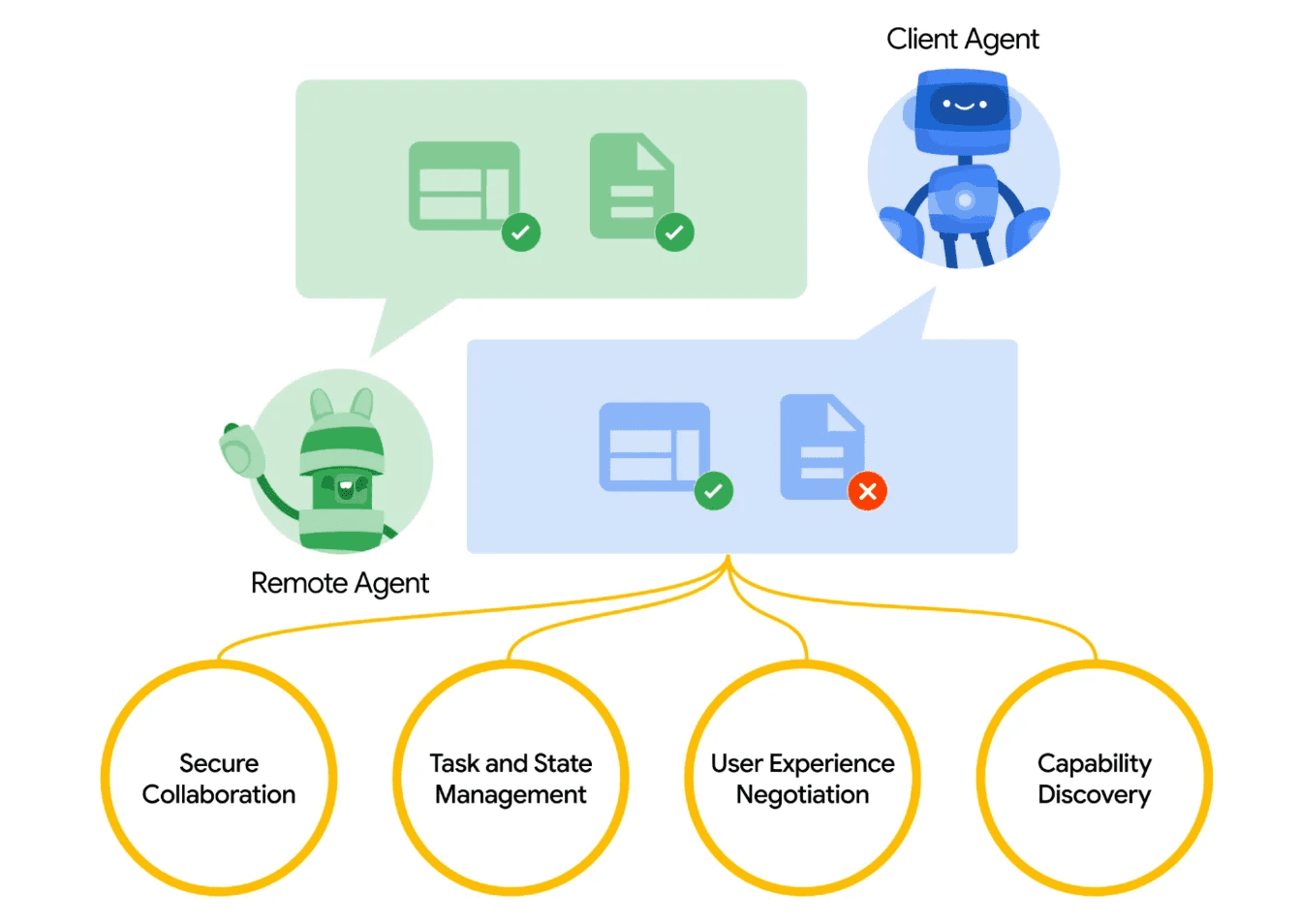
Client Agent — Formulates tasks and communicates them to remote agents
Remote Agent — Acts on tasks to provide information or perform actions
Agent Card — JSON metadata file describing an agent’s capabilities and endpoints
Task Management — Defines task objects with lifecycle stages and outputs
Messaging System — Allows agents to exchange context, replies, and artifacts
5.3 A2A Architecture Diagram
5.4 How A2A Works
A2A facilitates agent-to-agent communication through:
Capability Discovery — Agents advertise their skills via Agent Cards in JSON format
Task Management — Communication oriented toward task completion with defined lifecycle stages
Collaboration — Agents exchange messages containing context, replies, or artifacts
User Experience Negotiation — Messages include parts with specified content types
The protocol is built on established web standards (HTTP, SSE, JSON-RPC) and is secure by default with enterprise-grade authentication.
6. MCP vs A2A: Key Differences
6.1 Focus and Purpose
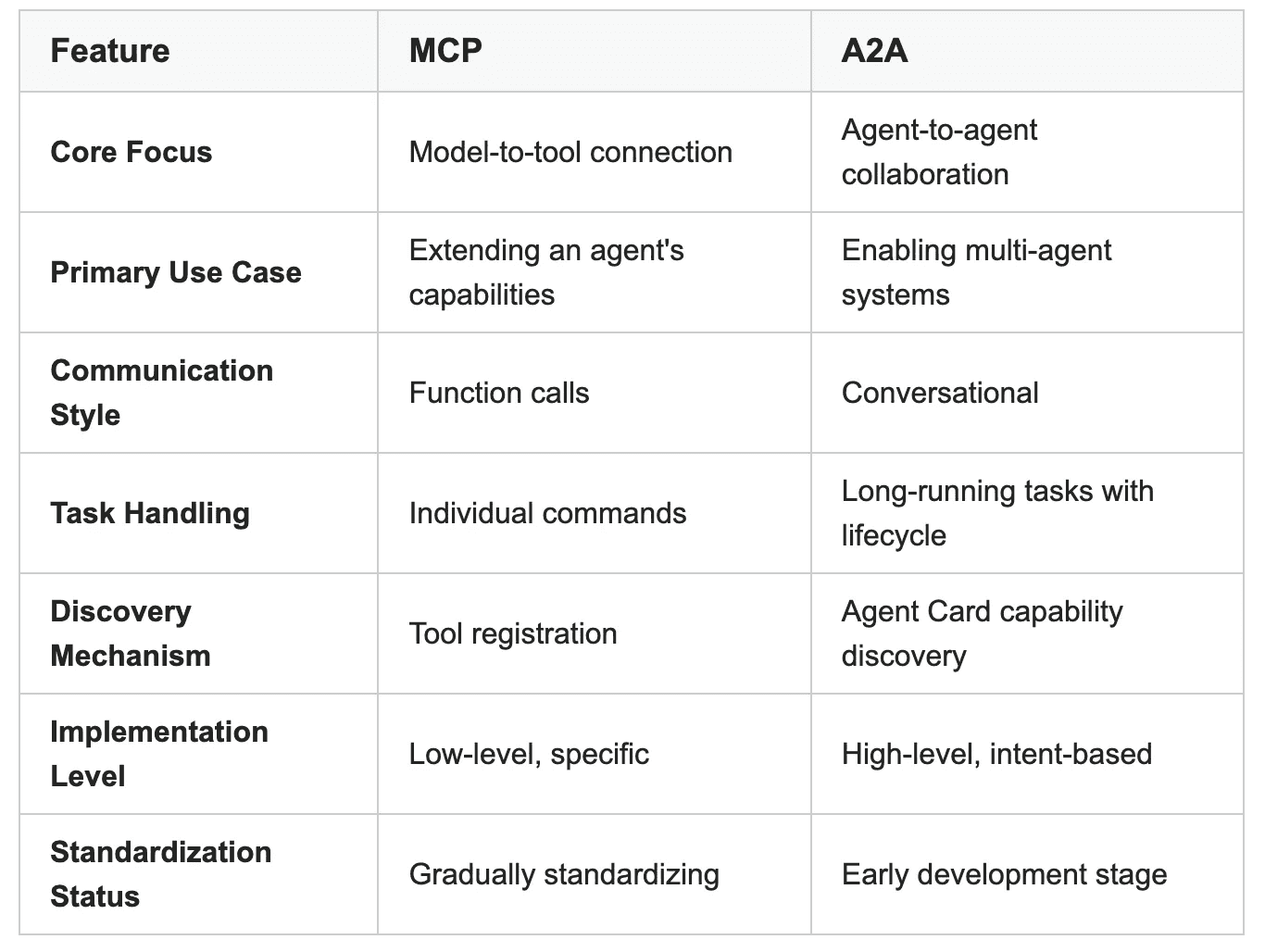
MCP focuses on connecting a single AI model to external tools and data sources. It’s primarily about extending what a single agent can do.
A2A focuses on enabling collaboration between multiple agents. It’s about coordinating distributed agent ecosystems.
6.2 Interaction Mode
MCP uses function calls and structured I/O for predictable, low-level tool access.
A2A uses conversational interactions supporting long-running tasks and dynamic coordination.
6.3 Abstraction Level
MCP operates at a lower level with explicit instructions for specific functionalities.
A2A functions at a higher level focused on intent and capabilities between agents.
6.4 Comparison Table
7. Suitable Scenarios for MCP
MCP is better suited for scenarios where:
Direct Tool Integration — AI assistants need access to structured data (databases, files, APIs)
Runtime Tool Discovery — Development teams prefer runtime tool discovery over pre-programmed connections
Data Access with Existing Infrastructure — Teams want to share internal data while keeping their existing infrastructure
Specialized Tools — Applications require direct access to specialized tools and data sources
Real-world examples where MCP excels:
Development environments where coding assistants need live coding context
Data analysis applications requiring access to multiple databases and APIs
Financial applications where AI needs secure access to internal financial data
8. Suitable Scenarios for A2A
A2A is more suitable for scenarios requiring:
Multi-Agent Collaboration — Complex workflows needing multiple specialized agents working together
Cross-System Automation — Enterprise workflows that cross department lines
Vendor-Agnostic Agent Interoperability — Getting agents from different vendors to work together
Complex Workflows — End-to-end processes like employee onboarding across HR, IT, and finance
Real-world examples where A2A excels:
Hiring workflows with different agents for sourcing, screening, and scheduling
Customer support systems spanning multiple backend services
Complex research tasks distributed across specialized knowledge agents
9. Complementary Nature of MCP and A2A
Rather than competing alternatives, MCP and A2A are complementary technologies that can be used together:
MCP provides a standard way for agents to access tools and data sources
A2A provides a standard way for agents to collaborate and coordinate
In a well-designed system, agents can use MCP to connect with their tools and data, while using A2A to collaborate with other agents on complex tasks.
10. MCP Sample Project
To get started with MCP, you can implement a simple MCP server that exposes tools and resources:
10. 1 Project Setup:
10.2 Create a basic MCP server (e.g., main.py):
10.3 Run the server:
10.4 Connect with Claude Desktop:
Install Claude Desktop
Edit the configuration file to connect to your MCP server
11. A2A Sample Project
For A2A, you can implement a simple currency conversion agent based on Google’s example:
11.1 Setup the Environment:
11.2 Run the A2A Agent:
11.3 Test with Client:
11.4 Example Interaction:
You can test the agent with queries like “Convert 100 USD to EUR” and see how it handles the conversation and performs the currency conversion task.
12. Conclusion
As of April 14, 2025, MCP and A2A represent two dimensions of AI agent development — MCP for tool integration and A2A for agent collaboration — signaling a shift from deterministic programming to autonomous, collaborative systems. Their complementary nature suggests a future where AI applications can think, adapt, and collaborate, revolutionizing software development. Teneo.ai and other platforms are monitoring these protocols for enterprise integration, with ongoing discussions on challenges like security, scalability, and legacy system adaptation (MCP and A2A Protocols Explained The Future of Agentic AI … | Teneo.ai, A2A and MCP: Start of the AI Agent Protocol Wars? | Koyeb).